Menu
Log in

Women in French

Log in

Calls for conferences

<< First  < Prev   1   2   3   4   5   ...   Next >  Last >> 
  • 22 Jun 2026 10:27 PM | Women in French Admin (Administrator)

    Title: Languages, Humanities, and Human Futures in the Age of Artificial Intelligence.

    As artificial intelligence increasingly transforms education, communication, research, translation, and cultural production, questions about the future of languages and the humanities have become more urgent than ever. While AI can generate texts, summarize research, facilitate translation, and provide access to vast amounts of information, it cannot fully replicate the human dimensions of meaning-making, cultural memory, ethical judgment, creativity, empathy, and lived experience that are central to language and the humanities.

    This roundtable invites scholars, educators, students, translators, and cultural practitioners to reflect on the enduring importance of language study and the humanities in an AI-driven world. How do languages shape human relationships, identities, communities, and worldviews? What roles do literature, history, philosophy, the arts, and cultural traditions play in preserving and transmitting collective memory and fostering intercultural understanding? How can AI serve as a tool for learning, accessibility, and innovation while reinforcing rather than replacing human expertise, critical thinking, and cultural engagement?

    Participants are encouraged to discuss both the opportunities and challenges posed by AI, including its impact on teaching, research, translation, cultural preservation, and global communication. The roundtable seeks to foster a constructive conversation about how languages and the humanities remain essential to sustaining human connection, cultural diversity, democratic dialogue, and creative innovation in the twenty-first century.

    Please submit your abstract directly to Dr. Latifa Zoulagh at latifazoulagh@gmail.com . 

  • 22 Jun 2026 10:24 PM | Women in French Admin (Administrator)

    Title: Women, Gender, and Culture in the Francophone World

    This open panel invites papers exploring the diverse cultural productions, experiences, and representations of women and gender in French and Francophone contexts. We welcome contributions that examine literature, film, visual arts, performance, media, popular culture, life writing, philosophy, and other forms of cultural expression from any historical period or geographical region of the Francophone world.

    Possible topics include, but are not limited to, questions of identity, memory, embodiment, creativity, migration, language, community, activism, cultural transmission, social change, and the intersections of gender with race, class, sexuality, disability, religion, and colonial histories.

    The panel seeks to foster interdisciplinary conversations that highlight the richness and diversity of women's and gendered experiences, voices, and cultural practices across the Francophone world.

    Papers employing a wide range of theoretical and methodological approaches are encouraged.

    Please submit your abstract directly to the panel chair, Dr. Latifa Zoulagh, at latifazoulagh@gmail.com .

  • 22 Jun 2026 5:42 PM | Women in French Admin (Administrator)

    From Migritude to Fémigritude: African Women Writers Theorizing Migration and Displacement

    Inspired by Jacques Chevrier's concept of migritude, which designates literary writing centered on migration and its displacements, this panel proposes the concept of Fémigritude as a theorectical framework for reading African women's literary and cultural representations of migration, and displacement. Building on Filomina Chioma Steady's theory of African feminism as rooted in material conditions of survival and extending the legacy of Négritude through a gendered lens, fémigritude names the epistemological interventions emerging from African women’s narratives of migration. This panel invites African women writers and filmmakers, whose works examine how migration restructures kinship networks, transforms motherhood into a site of political vulnerability, exposes women and children to state and structural violence, and compels women to navigate intersecting systems of oppression. These cultural productions theorize migration not as an individual tragedy, but as a structural condition shaped by necropolitics, border regimes, neoliberal precarity, climate insecurity, terrorism, and global inequality. These cultural works see migration as a structural situation influenced by necropolitics, border regimes, insecurity, terrorism, and global inequity. We welcome papers engaging literature, film, autobiography, testimony, performance, and other forms of cultural production written by African women that portray African women’s experiences of migration, displacement, survival, resistance and agency.

    Keywords: Migritude, fémigritude, migration, displacement, necropolitics 

    Please send abstracts of 250–300 words and a short bio to Diweng M. Dafong at
    mdafong@crimson.ua.edu

  • 22 Jun 2026 5:38 PM | Women in French Admin (Administrator)

    Salve Regina University, Newport, Rhode Island March 6–9, 2027

    Panel Chair: Adrienne Angelo

    Session format: Traditional panel

    Session title: Care and Embodied Vulnerability in Contemporary Francophone Studies

    Session proposal: 

    Contemporary Francophone cultural production increasingly turns to bodies under pressure: exhausted bodies, ill bodies, racialized and gendered bodies, aging bodies, maternal bodies, traumatized bodies, and bodies entangled with damaged environments. Drawing on feminist care ethics, from Joan Tronto’s insistence that care must be understood as a matter of politics, democracy, and justice to Pascale Molinier’s work on the gendered, affective, and often invisible labor of care, this session invites papers that examine how women, queer, and gender-expansive writers, filmmakers, artists, and thinkers represent embodied vulnerability as a relational and political condition that exposes the uneven distribution of care. Rather than approaching care as a purely private or ethical practice, this session asks how care is demanded, refused, withheld, institutionalized, or made impossible in Francophone cultural texts. How do cultural works represent bodies that require care, bodies that provide care, and bodies abandoned by families, institutions, states, or communities? How do gender, race, class, sexuality, disability, illness, age, migration, colonial history, and ecological precarity shape who is expected to care, who is deemed worthy of care, and whose vulnerability remains unseen? By placing feminist care ethics in dialogue with embodied vulnerability, this panel asks how contemporary Francophone cultural production gives form to dependence, exposure, and survival as political questions. What kinds of feminist critique become possible when vulnerability is understood as a condition shared unequally across human and more-than-human life?  Papers may address literature, cinema, visual culture, philosophy, life writing, or other cultural forms that explore these questions in relation to the forms of embodied vulnerability and care relations outlined above. The session especially welcomes approaches grounded in feminist theory, care ethics, affect theory, medical humanities, disability studies, ecocriticism, and postcolonial/decolonial feminisms.

    Please submit directly your abstract to the panel chair:
    Adrienne Angelo
    Professor of French
    Auburn University
    ama0002@auburn.edu

  • 28 Sep 2025 10:03 AM | Women in French Admin (Administrator)

    40e Congrès International du CIÉF
    Alcalá de Henares, Espagne | 22–26 juin 2026

    EN D’AUTRES MONDES
    Imaginaires francophones et utopies en mouvement

    Le Conseil International d’Études Francophones lance son appel à communications pour le congrès annuel qui se tiendra du 22 au 26 juin 2026 à Alcalá de Henares, ville historique espagnole, classée au patrimoine mondial de l’UNESCO. Célèbre pour avoir vu naître Miguel de Cervantès, cette cité universitaire située à une trentaine de kilomètres de Madrid est un carrefour intellectuel et culturel qui, depuis le Siècle d’or jusqu’à nos jours, cultive un dialogue vivant entre langues, mémoires et imaginaires. Ce cadre, riche en croisements et en circulations, est particulièrement propice à une réflexion sur les mondes multiples qui traversent les productions francophones contemporaines.

    Le thème de cette 40e édition, En d’autres mondes, invite à réfléchir aux manières dont les littératures, les arts, les pensées et les pratiques francophones imaginent, habitent, déplacent ou contestent les mondes existants. À l’heure des bouleversements géopolitiques, des mutations technologiques et des urgences écologiques, comment les œuvres et discours francophones participent-ils à la fabrique d’“Autres mondes” utopiques, décoloniaux, transidentitaires, linguistiques, diasporiques, imaginaires ou intimes ? Quels passages, quelles fractures, quelles utopies émergent dans ces espaces de création, de mémoire et de contestation ?

    Dans cet esprit, les travaux de penseurs comme Felwine Sarr, qui appelle à un renouvellement radical des imaginaires africains à travers une “esthétique de la relation” et une pensée de l’ouverture, offrent des pistes puissantes pour penser des mondes à venir. Dans Afrotopia, Sarr invite à rompre avec les modèles imposés de développement pour imaginer des trajectoires fondées sur les ressources culturelles et spirituelles propres aux sociétés africaines. De son côté, Achille Mbembe propose, dans ses réflexions sur le devenir-monde et l’“écologie du rapport”, une pensée du vivant et de l’interdépendance qui redéfinit les formes d’être ensemble. Ces approches critiques trouvent des échos dans les œuvres de Werewere-Liking, dont les textes mêlent mythe, oralité, féminisme et cosmogonie, ou encore dans les engagements de figures comme Rokhaya Diallo, qui reconfigurent les imaginaires sociaux et politiques depuis les marges.

    Qu’il s’agisse de revisiter des mythes anciens, de mobiliser la science-fiction comme langage de résistance, ou d’évoquer des formes de mémoire non-occidentales, les arts et pensées francophones ouvrent des espaces d’expérimentation et de projection vers d’“autres mondes” parfois rêvés, parfois critiques, toujours porteurs de possibles.

    Le CIÉF accueille des propositions individuelles (20 minutes) et de sessions complètes (3 à 4 participant·e·s) touchant, entre autres, aux axes suivants :

    • Fictions spéculatives et mondes possibles : utopies, dystopies, écopoétiques et post-humanisme
    • Imaginaires post-/décoloniaux : cosmopoétiques francophones, transferts culturels, résistances créatives
    • Déterritorialisations : migrations, exils, frontières, mobilités réelles et symboliques
    • Langue, identité, traduction : penser/lire/écrire entre mondes
    • Utopies queer, féministes, créoles et minoritaires
    • “Autres mondes” numériques : réseaux sociaux, IA, réalités virtuelles et augmentées
    • Expressions artistiques et nouvelles possibilités
    • Imaginaires de l’altérité : figures de l’étranger, minorités, métissages, créolisation
    • Rêveries/Récits de l’ailleurs : voyages, explorations, cartographies affectives et imaginaires, mondes intimes, oniriques, mystiques, subjectivités plurielles
    • Mémoire, réinvention, transmission : palimpsestes, intertextualités, héritages intergénérationnels
    • Espaces en marge : centres/périphéries, marges, seuils, territoires en mutation
    • Voix plurielles : polyphonie, dialogisme, discours de la relation
    • Conflits et solidarités : luttes politiques et culturelles, amitiés, fraternités, pratiques d’inclusion/exclusion
    • Poétiques du lien : politiques relationnelles, pédagogies de l’empathie et de l’altérité
    • Esthétiques intermédiales : cinéma, rap, arts numériques, blogues, graffiti, bande dessinée
    • Écopoétiques et géopoétiques : nature, environnement, territoire et imagination écologique
    • Espaces éducatifs : imaginaires de l’école, tensions entre modèle républicain et pluralisme culturel
    • Traduction de l’autre et de l’impossible
    • Nouveaux défis linguistiques dans un monde en mouvement
    • Langue française en question : domination, résistance, détournements poétiques

    Soumissions: 

    Les appels pour les sessions complètes doivent être soumis avant le 15 septembre 2025. 

    Les sessions complètes et les propositions de communications individuelles doivent être soumises avant le 15 octobre 2025. 

    Veuillez inclure un titre (15 mots), un résumé (250 mots). Les soumissions et les demandes de renseignements peuvent être soumises sur le site du CIÉF (https://secure.cief.org/wp/formcommunication/ ).

    Le CIÉF encourage la participation de chercheur·e·s, artistes, étudiant·e·s, écrivain·e·s et intellectuel·le·s du monde entier, et valorise les perspectives interdisciplinaires et les approches plurilingues.

    Pour toute question ou précision, n’hésitez pas à contacter Caroline Fache à presidente@cief.org

  • 26 Jul 2025 12:06 PM | Women in French Admin (Administrator)

    CONFÉRENCE WIF26 @ JMU HARRISONBURG, VA

    Thème de la conférence : Transgressions visibles et invisibles

    Nous avons le plaisir d’annoncer l’appel à communications pour notre prochaine conférence Women in French (WIF), qui se tiendra du 7 au 9 mai 2026, sur le thème « Transgressions visibles et invisibles ». Cette conférence vise à explorer les différentes dimensions et implications des transgressions, visibles ou invisibles, à travers divers champs disciplinaires et perspectives.

    La transgression est liée à la notion de limite et informe les frontières de ce qui est considéré comme acceptable. Dans son essai « Préface à la transgression », Michel Foucault explore la transgression, son rôle dans la société, et son rapport aux tabous, aux limites et au sacré. Dans son hommage à Georges Bataille, Foucault qualifie la transgression de « geste qui concerne la limite : c’est là, dans la minceur de la ligne, que se manifeste l’éclair de son passage, mais peut-être aussi tout son trajet, son origine même. La ligne qu’elle franchit pourrait bien être tout son espace » (1963). La transgression va au-delà de la simple violation des lois ou des normes ; elle devient un mouvement qui dépasse et complète la limite franchie.

    Le thème « Transgressions visibles et invisibles » explore la dynamique des transgressions sous différentes formes et dans divers contextes. Il interroge les actes qui défient les frontières, normes et tabous, à la fois comme « discours publics et cachés » (James Scott, 1990). Il invite ainsi à une réflexion sur la perception, la représentation et la régulation des transgressions. Cette conférence vise à explorer les multiples couches de la transgression et ses perspectives dans les structures sociales et politiques, y compris mais sans s’y limiter aux œuvres artistiques impliquant des dynamiques de pouvoir.

    Au-delà des différentes motivations derrière la transgression, plusieurs questions peuvent se poser : la transgression est-elle une forme d’agression ou une réaction ? Peut-elle être synonyme de résistance, de liberté ou de transformation sociale ? Qui définit ce qui est transgressif ? Que signifie transgresser ? Qui fixe les limites, et qui les franchit – en silence ou avec défi ? Comment la transgression peut-elle être représentée ? Quelles sont ses différentes strates ? Quel rôle joue-t-elle dans la dichotomie entre le sacré et le profane ? Quelles en sont les implications pour les individus et les sociétés ? Où se situe la frontière entre les transgressions visibles et invisibles ? Existe-t-il des limites à la transgression ? Peut-elle être déshumanisante, tout comme l’invisibilité, comme en discute Guillaume LeBlanc dans L’invisibilité sociale (2009) ?

    Ce thème invite à un dialogue interdisciplinaire autour des multiples formes de transgression – sociale, culturelle, politique, genrée, esthétique, linguistique ou spatiale – et de la manière dont elles sont rendues visibles, effacées, réduites au silence ou invisibilisées. 

    Nous accueillons les contributions qui interrogent la tension entre normativité et subversion, et les forces qui rendent certains actes ou corps plus visibles ou vulnérables que d’autres.

    Exemples de thématiques possibles (liste non exhaustive) :

    • Censure, résistance et politique de la visibilité
    • Transgressions de genre et queer
    • Transgressions en contexte postcolonial et décolonial
    • Langue, accent, code-switching comme lieux de transgression
    • Corps et frontières : migration, déplacement et exclusion
    • Représentations artistiques, littéraires et cinématographiques de l’interdit
    • Surveillance, opacité et droit à l’invisibilité
    • Religion, tabous et normes culturelles
    • Transgressions environnementales et justice climatique
    • Intersectionnalité et formes croisées de transgression

    Nous invitons les propositions de chercheurs, artistes et militant·e·s de divers domaines, notamment la littérature, le cinéma, les études de genre, les études culturelles, l’histoire, la sociologie, la philosophie, etc.

    Projet « One Book, One WIF »
    En partenariat avec nos collègues de WIF UK, Women in French participe au projet One Book, One WIF, lancé en 2017 par Stephanie Schechner pour promouvoir l’étude d’auteurs francophones peu connus. L’auteur sélectionné pour la conférence 2026 est Rajae Benchemsi pour son roman Lumière d’exil (Marrakech – bio : https://womeninfrench.org/current-selections). Les propositions d’articles ou de panels sur cet auteur et son œuvre sont les bienvenues.

    Session spéciale:« Enseigner la transgression/Enseignement et transgression »

    Cette session accueille des communications explorant, en théorie et en pratique, les concepts d’« enseigner la transgression » et d’ « enseignement et transgression », dans divers contextes disciplinaires et géographiques, au-delà du champ des études francophones. Enseigner la transgression renvoie à l’enseignement comme acte de libération et de rupture avec les normes, un enseignement critique qui pousse les étudiant·e·s à penser radicalement. Des ouvrages clés incluent Teaching to Transgress de bell hooks, Pédagogie des opprimés de Paulo Freire (1970), et Border Crossings de Henry Giroux (1992). Enseignement et transgression, quant à lui, analyse la manière dont les institutions éducatives provoquent, régulent ou réagissent aux actes transgressifs. Surveiller et punir (Foucault, 1975) et Teaching Positions (Elizabeth Ellsworth, 1997) sont des références importantes.

    Thèmes suggérés (liste non exhaustive):

    • Enseignement comme acte de libération ou de résistance
    • Pédagogie critique et pratiques pédagogiques radicales
    • Politique du savoir, autorité et dynamique en salle de classe
    • Discipline institutionnelle, surveillance et transgression
    • Pédagogies du risque, du malaise ou du dissentiment
    • Transgressions des normes institutionnelles
    • Intersectionnalité et transgression dans l’enseignement
    • Approches postcoloniales, féministes ou décoloniales de l’enseignement
    • Études comparées des méthodes d’enseignement

    Les propositions peuvent s’appuyer sur des cadres théoriques, des études de cas ou des expériences pédagogiques illustrant ou remettant en question les limites entre enseignement, apprentissage et transgression.

    Modalités de soumission :
    Les propositions de communications individuelles ou de panels sont acceptées.

    • Langues acceptées : français et anglais
    • Longueur du résumé : 250 à 300 mots
    • Titre de la communication : 100 caractères maximum

    Pour les panels :
    Une seule personne (modérateur/modératrice ou organisateur·rice) doit soumettre la proposition pour l’ensemble du groupe. Merci de rassembler les informations suivantes à l’avance :

    • Titre du panel
    • Résumé général du panel
    • Nom du ou de la modérateur·rice
    • Coordonnées, titres des communications, résumés (250–300 mots) et courtes bios (100 mots max) pour chaque participant·e (3 à 5 intervenant·e·s)

    Pour soumettre une proposition : veuillez suivre le lien : 
    https://jmu.questionpro.com/WIF2026.

    Coordonnées :
    Pour toute question, n’hésitez pas à contacter Dr. Amina Saidou à l’adresse suivante : saidouax@jmu.edu. Nous attendons vos propositions avec impatience !

    Dates importantes :

    • 19 octobre 2025 : Date limite de soumission des propositions
    • 19 décembre 2025 : Notification d’acceptation ou de refus
    • 9 janvier 2026 : Date limite pour l’inscription anticipée
    • 30 janvier 2026 : Date limite pour l’inscription normale
    • 27 février 2026 : Date limite pour l’inscription tardive (en ligne uniquement)
    • 27 février 2026 : Les intervenant·es sélectionné·es par le comité scientifique doivent être membres de Women in French à cette date pour pouvoir présenter. Si vous n’êtes pas encore membre, vous pouvez bénéficier d’une adhésion gratuite d’un an. Après acceptation, veuillez contacter Anne Marcoline @ marcoline@uhcl.edu).
    • 3 avril 2026 : Date limite pour demander un remboursement en cas de désistement

    Organisatrices et Comité de sélection :
    Dr. Amina Saidou : saidouax@jmu.edu
    Dr. Verónica Dávila Ellis : davilave@jmu.edu
    Dr. Yenisei Montes de Oca : montesyx@jmu.edu 
  • 26 Jul 2025 11:56 AM | Women in French Admin (Administrator)

    WIF26 CONFERENCE @ JMU HARRISONBURG, VA

    Conference theme: Visible and Invisible Transgressions

    We are pleased to announce the call for papers for our upcoming WIF conference to be held May 7–9, 2026, on the theme “Visible and Invisible Transgressions.” This conference seeks to explore the various dimensions and implications of transgressions, both visible and invisible, across a range of disciplines and perspectives.

    Transgression is tied to the idea of limitation and informs the boundaries of what is considered acceptable. In his essay “A Preface to Transgression,” Michel Foucault explores the concept of transgression, its role in society, and its relationship to taboos, limits, and the sacred. In his tribute to Georges Bataille, Foucault refers to transgression as “a gesture that concerns the limit: It is there, in this thinness of the line, that the flash of its passage is manifested, but perhaps also its entire trajectory, its very origin. The line it crosses could well be its entire space” (1963). Transgression goes beyond mere violation of laws or norms to becoming a movement that exceeds and complements the limit it crosses.

    The conference theme “Visible and Invisible Transgressions” explores the dynamics of transgression in various forms and contexts. It seeks to examine acts that challenge boundaries, norms, and taboos, both as “public and hidden transcripts” (James Scott, 1990). It invites discussions on the perceptions, representations, and regulations of transgression. The conference aims to delve into the different layers of transgression and its prospects in various social and political structures, which include but are not limited to any work of art involving power dynamics.

    Beyond the various reasons or motives behind transgression, some questions may arise. Is transgression a type of aggression, or is it reactionary? Can transgression equate to resistance, freedom, or social transformation? What is deemed transgressive? What does it mean to transgress? Who defines the boundaries, and who crosses them, silently or defiantly? How can transgression be displayed? What are the layers of transgression? What role or purpose can transgression play in the dichotomy of the sacred and the profane? What are the implications of these transgressions for individuals and societies? What is the layer between visible and invisible transgressions? Are there limits to transgression? Can transgression be dehumanizing, just like invisibility, as discussed, for example, by Guillaume LeBlanc in L’invisibilité sociale (2009)?

    This theme invites interdisciplinary dialogue on the multiple ways in which transgressions – social, cultural, political, gendered, aesthetic, linguistic, or spatial – are made visible, erased, silenced, or rendered invisible. We welcome contributions that interrogate the tension between normativity and subversion, and the forces that make certain acts or bodies more visible or vulnerable than others.

    Topics may include but are not limited to:  

    • Censorship, resistance, and the politics of visibility
    • Gender and queer transgressions
    • Transgressions in postcolonial and decolonial contexts
    • Language, accent, and code-switching as sites of transgression
    • Bodies and borders: migration, displacement, and exclusion
    • Artistic, literary, and cinematic representations of the forbidden
    • Surveillance, opacity, and the right to invisibility
    • Religion, taboo, and cultural normativity
    • Environmental transgressions and climate justice
    • Intersectionality and layered forms of transgression  

    We welcome abstracts from scholars, artists, and activists across disciplines including literature, film studies, gender studies, cultural studies, history, sociology, philosophy, and more.  


    « One Book, One WIF » Project:
    In partnership with our colleagues at WIF UK, Women in French is participating in the “One Book, One WIF” project. Established in 2017 by Stephanie Schechner, this program promotes the study of little-known French or French-speaking authors. The author selected for the 2026 conference is Rajae Benchemsi for her novel Lumière d’exil (Marrakech - bio https://womeninfrench.org/current-selections). We welcome proposals for papers or panels on this writer and her work.


    Special Session:Teaching Transgression/Teaching and Transgression”
    This panel invites papers that explore the concepts of Teaching Transgression and Teaching and Transgression, both in theory and in practice, across regions and fields of study beyond the scope of French/Francophone Studies.

    Teaching Transgression refers to teaching as an act of boundary-breaking and liberation, designing courses that deliberately challenge conventional ideas and encourage students to think critically and radically. Key works include bell hooks’ Teaching to Transgress, where teaching is framed as an act of rebellion and freedom; Paulo Freire’s Pedagogy of the Oppressed (1970), where critical pedagogy becomes a tool of emancipation; and Henry Giroux’s Border Crossings: Cultural Workers and the Politics of Education (1992), which portrays education as a site for cultural resistance and political struggle. In this sense, teaching invites students to question authority, cross social, political, and cultural boundaries, and imagine new possibilities.

    By contrast, Teaching and Transgression considers education and acts of transgression as two related but not necessarily merged phenomena. This approach may involve studying how educational institutions provoke, regulate, or respond to acts of transgression. Michel Foucault’s Discipline and Punish (1975) provides a framework for understanding how schools and institutions discipline behavior through knowledge and power structures. Elizabeth Ellsworth’s Teaching Positions: Difference, Pedagogy, and the Power of Address (1997) further examines how power, race, and identity interact with teaching practices, often revealing moments of transgression within pedagogical spaces.

    This session welcomes proposals that include, but are not limited to, the following topics:

    • Teaching as an act of liberation or resistance
    • Critical pedagogy and radical teaching practices  
    • The politics of knowledge, authority, and classroom dynamics  
    • Institutional discipline, surveillance, and transgression  
    • Pedagogies of discomfort, risk, and dissent 
    • Discomfort in classrooms
    • Transgressing institutional norms
    • Intersectionality and transgression in educational settings  
    • Postcolonial, feminist, or decolonial approaches to teaching transgression  
    • Comparative studies of teaching methods across disciplines or institutions

    Papers may engage theoretical frameworks, offer case studies, or reflect on pedagogical experiences that illustrate or challenge the boundaries between teaching, learning, and transgression.

    Submission Guidelines: 
    We welcome proposals for individual papers or panels.

    • Submissions in both languages (French and English) are accepted.
    • Length of abstract to be submitted: 250-300 words
    • The length of the title of the papers: 100 characters maximum

    Note for Panel Submissions:
    For panel proposals, only one person, typically the panel organizer and/or moderator, should submit the proposal on behalf of the group. Please collect all required information in advance. The submission form will ask for:

    • Panel title
    • Panel overview describing the theme and objectives
    • Name of moderator
    • Contact information, paper titles, abstracts (250–300 words), and short bios (max 100 words) for each panelist (min 3, max 5 presenters)

    For all submissions, please follow the link: https://jmu.questionpro.com/WIF2026.

    Contact Information: For any questions, feel free to contact Dr. Amina Saidou @ saidouax@jmu.edu.  
    We look forward to receiving your proposals. 

    Timetable:

    • October 19, 2025: submission of proposals
    • December 19, 2025: notification of acceptance or rejection. 
    • January 9, 2026: end date for early registration 
    • January 30, 2026: normal registration ends
    • February 27, 2026: Late registration online
    • February 27, 2026: Speakers selected by the Scientific Committee must be members of Women in French before this date in order to present. Also, if you are not a current WIF member, you can get the introductory free one-year membership. Upon acceptance, please contact Anne Marcoline @ marcoline@uhcl.edu)
    • April 3rd, 2026: deadline for refund in case of withdrawal

    Organizers and Selection Committee:
    Dr. Amina Saidou: saidouax@jmu.edu
    Dr. Verónica Dávila Ellis : davilave@jmu.edu
    Dr. Yenisei Montes de Oca : montesyx@jmu.edu 


  • 1 Jun 2025 4:53 PM | Anonymous member (Administrator)

    Les mots du genre. Circulation, traduction et interdisciplinarité
    Date de tombée : 01 septembre 2025
    Université du Québec à Trois-Rivières, 21-23 mai 2026

    Dans le récent Qui a peur du genre ? (2024), Judith Butler s’interroge sur la traduction et, de façon concomitante, sur la circulation des concepts dans les études de genre :

    Parfois le mot ne marche pas dans d’autres langues, et parfois il se découvre des cousins linguistiques qu’il ignorait avoir. La saillance du terme dépend de la traduction, mais affirmer cette traduction altère souvent la signification d’un mot quand il arrive dans une autre langue et dans un autre contexte. (Butler, 2024, p. 54)

    En effet, les déplacements culturels, disciplinaires et linguistiques des mots du genre nécessitent de repenser les moyens et réseaux de signification empruntés pour définir. De plus, le passage d’une langue ou d’une culture à l’autre, voire entre plus d’une langue et plus d’une culture, par la friction que ce mouvement suscite, fait saillir des nuances et des significations nouvelles.

    La traduction des mots du genre, féministes et intersectionnels, ont des effets multiples, qui permettent de réfléchir à nouveaux frais les concepts. D’abord, elle est nécessaire pour lutter contre un impérialisme de l’anglais dans le champ (lequel se fait de plus en plus patent, alors qu’on parle par exemples en français des éthiques du care et des politiques queer), tout en pouvant mener à plus de malléabilité politique. Réfléchir aux « mots du genre » de façon interculturelle et interlinguistique, c’est aussi permettre à des pensées d’interagir de façon transnationale. Cette perspective transnationale permettant, explique Zahra Ali, de « transcender, de secouer (nefada) et de remettre en question les frontières nationales, de genre et de sexualité [et de] rompre avec l’idée d’un ‘ici’ et d’un ‘là-bas’ correspondant à une géographie imaginée qui nourrit les féminismes blancs hégémoniques du Nord » (Ali, 2023, p. 149). Enfin, et justement parce qu’un mot peut rarement être parfaitement « transposé » d’une langue à l’autre, les différentes résistances qu’offre la traduction sont fécondes : elles demandent de dénaturaliser le « texte » comme ce qui viendrait simplement représenter un fait naturel et pré-discursif. En ce sens, la traduction et l’«intraduisibilité » de ces mots sont au centre même du fondement théorique des études de genre, et lorsqu’interrogées, elles viennent créer de l’étrangeté dans la langue, forcent à remanier les termes en les faisant toujours trembler, réfutent l’apparente transparence du discours.

    Les déplacements linguistique et culturel ont été au centre de la théorisation des études du genre occidentales du Nord global, émergeant de la rencontre entre la « French theory » et la littérature comparée nord-américaine. Ainsi, Anne Emmanuelle Berger, dans Le Grand Théâtre du genre, raconte qu’« après avoir assisté à la fabrication de la ‘pensée française’ aux États-Unis, [elle a] assist[é], de retour en France, à la ‘réinvention’ des Gender Studies, supposées ‘débarquer’ des États-Unis » (Berger, 2013, p. 10).  Si les mots du genre sont, dans cette généalogie franco-états-unienne, toujours déjà venus d’ailleurs (tenus comme des étrangers, et considérés comme tels par leurs détracteurs), ils ont toutefois eu tendance à se fixer dans l’anglais. Penser de façon critique les traductions des mots du genre, c’est chercher à les sortir de l’impérialisme des ornières anglo-occidentales, blanches et androcentrées, et se rappeler que les politiques queer sont, par définition, transfrontalières (Preciado, 2003). C’est aussi penser, avec les écoféministes (Haraway, 1991, 2016; d’Eaubonne, 1974) aux relations possibles ou impossibles entre différentes oppressions, capitalistes, patriarcales et coloniales. C’est, donc, critiquer, comme a pu le faire la pensée intersectionnelle (hooks, 1981; Creenshaw, 1989, 1991), la tentation d’une « traduction » trop directe entre les luttes propres à chaque oppression, qui tend à effacer, au sein du féminisme, les nuances et la spécificité des expériences des minorités. En ce sens, réfléchir la traduction et les déplacements des mots du genre à partir des limites épistémologiques ou apories de la langue (Athanasiou, 2003), c’est se rappeler que le savoir est situé, non seulement de façon expérientielle, mais aussi culturellement, linguistiquement et disciplinairement. 

    Car les théories féministes et les questions queer sont, d’emblée, interdisciplinaires. Tout comme pour la traduction linguistique, ce voyage entre les disciplines crée à son tour de nécessaires frottements dans les définitions, des mésententes qu’il faut interroger. Comment envisage-t-on l’« asexualité » en sociologie, comment la comprend-on en médecine ? Comment les « savoirs situés » peuvent-ils émerger des sciences de la nature, pour aller vers l’anthropologie, et la philosophie ?  Enfin, comment le détournement des mots et des discours d’une discipline vers l’autre sont-ils reliés épistémologiquement aux politiques queer ?, Preciado expliquant que « les corps de la multitude queer sont aussi des réappropriations et des détournements des discours de la médecine anatomique et de la pornographie, entre autres, qui ont construit le corps straight et le corps déviant modernes » (Preciado, 2003, p. 22).

    C’est donc la (non)définition, jamais claire et définitive, des « mots du genre » à l’aune de leurs déplacements que nous voulons étudier/analyser/débattre dans ce colloque. La difficulté à traduire ces mots, figures et concepts remettrait en question l’unicité d’un sens qui soit figé, et qui puisse, tel quel, traverser langues, cultures et disciplines. En ce sens, la circulation des mots du genre demande de toujours remettre en scène la centralité du langage, du discours et de sa performativité dans la réflexion politique. Elle est au cœur des possibilités politiques d’association horizontale, alors que « la traduction est la condition de possibilité d’un féminisme transnational et d’une solidarité effective contre le mouvement idéologique anti-genre. » (Butler, 2024, p. 54)

    Les propositions de communications et les propositions de panel doivent être envoyées à l’adresse lesmotsdugenre@gmail.com d’ici le 1er septembre 2025. Nous invitons des communications portant notamment (mais pas exclusivement) sur les axes suivants :

    • La répercussion de la définition d’un mot sur un concept lié aux théories du genre
    • L’impérialisme linguistique et les approches décoloniales ou postcoloniales des théories du genre 
    • L’impact d’un transfert culturel ou linguistique sur une notion liée au genre, ou la proposition de traductions alternatives
    • La définition de notions féministes / queer émergeant de cultures non-occidentales et leur circulation
    • La démarche ou analyse de la traduction linguistique d’une œuvre féministe ou queer
    • Les déplacements entre disciplines d’un terme lié au genre
    • La généalogie des concepts, des figures, des imaginaires du genre (temporalité non-linéaire)

    Nous vous encourageons aussi à proposer des séances interdisciplinaires, interlinguistiques ou interculturelles (de 3 ou 4 personnes), autour d’une seule notion ou d’un mot. Dans le cadre des séances ainsi constituées, chaque communication n’a pas à penser la circulation du terme, laquelle sera prise en charge par la globalité du panel. 

    Les présentations peuvent avoir lieu dans une des trois langues (français, anglais ou espagnol), mais les discussions seront en français.

    Le colloque se déroulera à l’Université du Québec à Trois-Rivières du 21 ou 23 mai 2026.


    Ce colloque est organisé en partenariat avec le Dictionnaire du genre en traduction. Nous prévoyons une publication d’une sélection des communications dans le cadre de cet ouvrage en ligne.

  • 1 Jun 2025 4:50 PM | Anonymous member (Administrator)

    The Words of Gender. Circulation, Translation, and Interdisciplinarity
    Deadline: 1 September 2025
    Université du Québec à Trois-Rivières, May 21–23, 2026

    In the recent Who’s Afraid of Gender? (2024), Judith Butler reflects on translation and, concurrently, on the circulation of concepts within gender studies.

    Sometimes a word does not work in other languages, and other times it discovers linguistic cousins it never knew it had. The salience of the term depends on translation, and affirming that translation often alters the meaning of a word as it arrives in another language and another context. (Butler 2024: 35).

    Indeed, the cultural, disciplinary, and linguistic displacement of gendered language calls for a reconsideration of the semiotic pathways and networks used to define key terms. The movement from one language or culture to another—or among multiple languages and cultures—creates friction that brings to light new nuances and meanings.

    The translation of gender-related, feminist, and intersectional terms produces a range of effects that invite fresh conceptual reflection. On one hand, translation is necessary to resist the increasing imperialism of English in the field (as seen, for example, in the adoption of ethics of care or queer politics in francophone scholarship), while also enabling greater political flexibility. Thinking about “the words of gender” through an intercultural and interlinguistic lens allows for the transnational dialogue of ideas. As Zahra Ali explains, this transnational perspective enables us “to transcend, to shake up (nefada), and to challenge national, gender, and sexual boundaries [and to] break with the idea of a ‘here’ and a ‘there’ mapped onto an imagined geography that sustains hegemonic white feminisms of the Global North” (Ali 2023: 149). Crucially, because no word can be perfectly “transposed” from one language to another, the resistances inherent to translation are intellectually generative: they compel us to denaturalize a “text” as something that might otherwise be seen as merely representing pre-discursive or natural facts. In this sense, the translation—and untranslatability—of such words lies at the very heart of the theoretical foundations of gender studies. When examined critically, translation introduces a productive strangeness into language, forces us to rework our terms, and undermines the illusion of discursive transparency.

    Linguistic and cultural shifts have long been central to gender theory in the Western academy, particularly in the Global North, emerging from the entangled genealogies of French theory and North American comparative literature. Anne Emmanuelle Berger, in Le Grand Théâtre du genre, recalls that “after witnessing the making of ‘French thought’ in the United States, [she then] observed the ‘reinvention’ of Gender Studies upon returning to France, as if they had just ‘arrived’ from the U.S.” (Berger 2013: 10; our translation). Within this Franco-American genealogy, the words of gender are always already foreign—treated as outsiders and regarded as such by their critics—but they have nonetheless tended to become anchored in English. To critically reflect on the translation of gender-related terminology is to work toward freeing these terms from the grip of Anglo-Western, white, androcentric paradigms, and to remember that queer politics are, by definition, transborder (Preciado 2003). This also requires engaging with ecofeminist thought (Haraway 1991; 2016; d’Eaubonne 1974) on the possible or impossible relations among various systems of oppression—capitalist, patriarchal, and colonial. As intersectional thinkers have argued (hooks 1981; Crenshaw 1989; 1991), a too-direct “translation” of struggles across axes of oppression risks erasing within feminism the nuance and specificity of minoritized experiences. To reflect on the translation and displacement of gendered terms through the epistemological limits or "aporias of language" (Athanasiou 2003) is to acknowledge that knowledge is situated not only experientially, but also culturally, linguistically, and disciplinarily.

    Feminist theories and queer questions are, from the outset, interdisciplinary. Much like linguistic translation, disciplinary border crossings generate productive friction in definitions and call for the interrogation of misunderstandings. How, form instance, is “asexuality” conceptualized in sociology, and how is it understood in medicine? How can “situated knowledges” emerge from the natural sciences and migrate into anthropology or philosophy? How are disciplinary shifts in terminology epistemologically linked to queer politics? Preciado notes that “the bodies of the queer multitude are also reappropriations and détournements of discourses from anatomical medicine and pornography, among others, which have constructed the modern straight and deviant body” (Preciado 2003: 22; our translation).

    This conference invites critical reflection on the (non)definition of “the words of gender” as revealed through their movements. The difficulty of translating these terms, figures, and concepts calls into question the fixity of meaning and its ability to cross languages, cultures, and disciplines unchanged. Thus, the circulation of gendered terminology urges us to foreground the centrality of language, discourse, and performativity in political thought. It lies at the heart of the horizontal political possibilities of coalition, insofar as “translation is the condition of possibility for transnational feminism and effective solidarity against the ideological anti-gender movement” (Butler 2024: 35).

    Paper and panel proposals must be submitted to lesmotsdugenre@gmail.com by September 1, 2025. We particularly welcome proposals addressing (but not limited to) the following themes:

    • The conceptual consequences of defining a term in gender theory
    • Linguistic imperialism and decolonial or postcolonial approaches to gender theory
    • The impact of cultural or linguistic transfer on a gender-related concept, or proposals for alternative translations
    • The definition and circulation of feminist/queer terms emerging from non-Western cultures
    • Approaches to or analyses of the linguistic translation of a feminist or queer work
    • Disciplinary shifts in the meaning or usage of gender-related terms
    • Genealogies of concepts, figures, or imaginaries of gender (non-linear temporalities)

    We also encourage proposals for interdisciplinary, interlinguistic, or intercultural panels (3 or 4 participants) organized around a single term or concept. In such sessions, individual presentations need not all address the term’s circulation directly; the panel as a whole will be expected to address this dimension.

    While presentations can be in either of the three languages (French, English or Spanish), discussions will happen in French.

    The conference will be held at the Université du Québec à Trois-Rivières from May 21 to 23, 2026.

    This event is organized in partnership with the Dictionary of Gender in Translation. A selection of papers will be considered for publication in this online volume.

  • 30 Mar 2025 6:59 PM | Women in French Admin (Administrator)

    Women in French Sessions
    2025 Midwest Modern Language Association Conference
    Marquette University / Milwaukee, WI
    November 14-16, 2025
    https://www.midwest-mla.org/


    “Writing Hope, Living Resilience: Feminist, Queer, and Trans Voices in French-Language Contexts”

    Women in French invites papers for a session at the 2025 Midwest Modern Language Association Conference themed “The Humanities is Where Hope Lives.”

    We seek submissions exploring how women, nonbinary, transgender, and queer writers, artists, and thinkers within French-language contexts across time periods cultivate hope and resilience through their work.

    We invite submissions from all Women in French members, regardless of their geographic location. International and independent scholars are also strongly encouraged to contribute. Women in French offers a complimentary one-year membership to new members. Additionally, competitive travel funds are available for graduate students.

    Papers might consider:

    • The poetics of hope in contemporary feminist, queer, and trans writing
    • Historical perspectives on women's and gender-diverse resilience in Francophone literature
    • Intersectional reimaginings of social and political futures
    • Collective storytelling as resistance
    • Intergenerational narratives of survival and renewal
    • Queer and trans eco-feminist visions of sustainability and hope

    Please submit a 250-word abstract and brief bio by April 25, 2025, to Adrienne Angelo ama0002@auburn.edu.


    “Hope, Resilience, and Feminist Political Agency in French-Language Online Participative Culture”

    While increasing critical attention has been placed on social media and (micro)blogging as a means of political discourse, this discussion has often focused on the products of online participative culture, rather than on the root causes that led individual actors to adopt glocalized forms of political action. This is especially the case with women’s online activism, which has historically operated outside of institutionalized avenues of social discourse and has consequently offered a privileged means of self-expression and collective association that transgresses – or at the very least, calls into question – gendered norms and societal expectations. In accordance with the MMLA’s 2025 presidential theme, Women in French invites papers that examine how productive dimensions of hope and social resilience have led women to leverage the participative culture of the Internet as a means of engaging with public opinion and advocating for social change.

    We invite submissions from all Women in French members, regardless of their geographic location, and offer a complimentary one-year membership to new members.

    Possible topics include, but are certainty not limited to:

    • Women’s motivations for glocal political activism in Francophone Europe (e.g., antiracist marches, women’s marches, etc.) or the MENA region (e.g., the Arab Spring, the Hirak, the Thawra, etc.)
    • The differential motivations for employing – and the different utility of – social media and online activism in “Western”, “Third World”, and “Decolonial” feminism
    • Digitally mediated forms of Sisterhood and the rise of intersectional forms of solidarity (e.g., feminism and antiracism, decolonial activism and antifascism, etc.)

    Please submit a 250-word abstract and brief bio by April 25, 2025, to Eric Wistrom, wistrom@uwalumni.com.

<< First  < Prev   1   2   3   4   5   ...   Next >  Last >> 


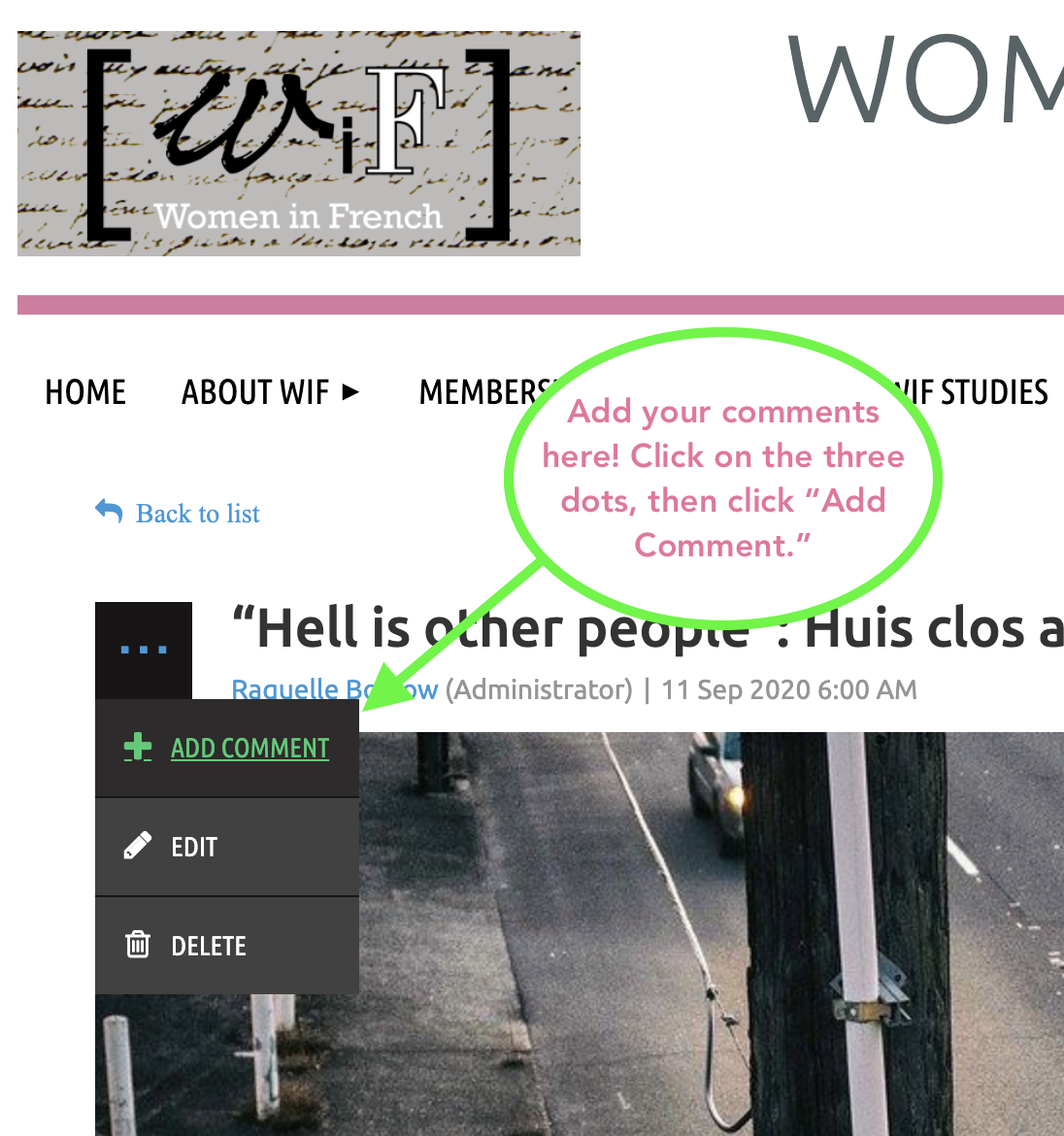
Want to add a comment? See the instructions below! 


Are you interested in contributing to our community blog? Read the Description and Contributor's Template and contact our Website Coordinator (womeninfrenchorg@gmail.com) so that we can talk! 

Questions?
membership@WomenInFrench.org

Follow WIF

Powered by Wild Apricot Membership Software